
Getting started
What Voluminate is built for today
An honest look at what our AI has been trained and optimised for — and what to expect from other inputs.
Last updated 10/08/2026
Voluminate is yours to experiment with. This guide is not a list of rules about what you are allowed to upload — it is an honest explanation of what our AI has actually been trained and optimised for today, so you know what kind of result to expect from different inputs. If you try something outside that scope out of curiosity, that is genuinely welcome. We would love to hear what you found.
Where results are strongest
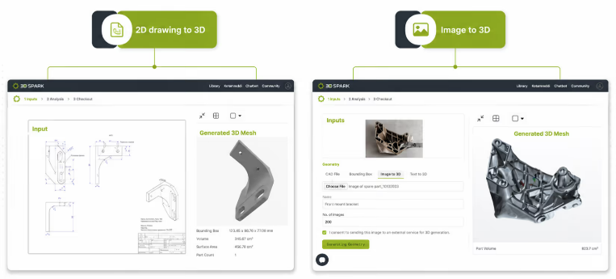
Voluminate's AI has been trained and optimised on individual mechanical parts — the kind that get manufactured by CNC machining, casting, injection moulding, forging, sheet-metal fabrication or additive manufacturing — shown as either a technical drawing or a photo of the physical part.
Typical examples: housings, brackets, flanges, shafts, gears, machined blocks, cast or moulded enclosures, sheet-metal panels, mounting plates, custom fixtures and spare parts for installed equipment. The common thread is a single component with a definable geometry, ideally with material and tolerance information.
Read on
- Technical drawings that work well — what sits squarely in what the system was trained on, with real examples
- Photos that work well — how many photos to take, and why roughly 90 degrees apart
- Input types we have not focused on yet — schematics, mechanisms, electronics and everything else
- Using the part brief effectively — what to tell us that the image alone cannot
- Getting the best result — assemblies, scale references, quality scores and what to try next